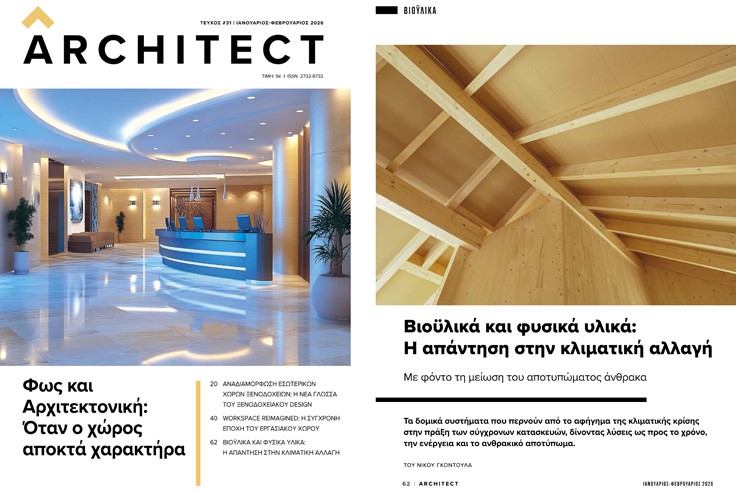
ARCHITECT Issue #31 — Special Feature: “Biobased and Natural Materials: The Answer to Climate Change”
In the January–February 2026 issue of ARCHITECT magazine, a special feature is dedicated to bio-based materials and their role in contemporary architecture.
On pages 63–64, the issue includes an interview with Iliana Kostaki, Co-Founder of CLT Greece, discussing CLT as a load-bearing structural system made from a renewable raw material and its contribution to bioclimatic construction in Greece.
Magazine Pages


View the Full Article / PDF
We would like to thank ARCHITECT and journalist Mr. Nikolaos Gkountoulas for the invitation and for their thoughtful, well-documented journalistic approach to the subject.
View the Full ArticleThe Role of CLT in Contemporary Construction
The discussion around bio-based materials, natural materials, and low-carbon construction is becoming increasingly relevant both internationally and in Greece. Within this context, CLT (Cross-Laminated Timber) is drawing growing attention as a modern load-bearing structural system that combines industrial precision, speed of construction, and strong environmental value.
Inspired by the relevant feature in ARCHITECT, it is worth taking a closer look at why CLT is now considered one of the most important solutions in the field of mass timber construction and masstimebr, how it connects to bioclimatic architecture, and why it is particularly well suited to the needs of the Greek market.
What Is CLT (Cross-Laminated Timber)?
clt-cross laminated timber is a load-bearing timber structural system in which multiple layers of wood are bonded together in alternating directions, with each layer placed perpendicular to the previous one. The result is a stable, solid, and predictable structural element suitable for walls, slabs, and other primary load-bearing applications.
The essence of the system lies in the fact that a large part of the construction process is transferred from the job site to the factory. This creates a model of high-precision prefabrication, where assembly, organization, and speed become the defining characteristics of the on-site phase.
Why Is CLT Associated with Sustainable Construction?
Interest in CLT is not only about wood as a material, but also about the broader construction model that comes with it. This system supports projects with better quality control, fewer errors, less uncertainty on site, and greater predictability during planning and execution.
At the same time, when the raw material comes from responsibly managed forests, timber is linked to a more responsible and sustainable production logic. This is why CLT has become central to the international discussion around lower carbon footprints, energy-efficient building envelopes, mass timber construction, masstimebr, and modern bio-based materials.
The Practical Advantages of CLT
- high-precision prefabrication,
- faster progress on site,
- fewer repetitive or corrective works,
- better predictability in scheduling and coordination,
- reduced construction risk,
- consistent quality in the final result.
This is especially important in projects where timing, precision, and overall project management directly affect both cost and final investment performance.
CLT and the Greek Context
The Greek context creates a particularly promising environment for the use of CLT. High seismic activity, the need for lighter construction solutions, time pressure in tourism-related developments, and the demand for strong energy performance all make industrialized timber systems especially relevant.
- In seismic regions, the lower structural weight is a critical advantage.
- In tourism projects, delivery speed directly affects return on investment.
- In extensions and retrofit interventions, a lighter solution reduces the load imposed on the existing structure.
- In residential and commercial buildings, the natural materiality enhances the quality of the indoor environment.
Is CLT Expensive?
The evaluation of CLT should not be limited to the price of the material alone. It is a comprehensive structural system that affects construction time, labor, on-site errors, job-site organization, and the overall operational performance of the building.
That is why the real question is not simply “How much does the material cost?”, but rather “What is the total project cost, and what do I gain in terms of time, quality, and life-cycle performance?”.
Conclusion
The feature in ARCHITECT confirms that the discussion around bio-based materials, natural materials, CLT, clt-cross laminated timber, and masstimebr has clearly moved from theory into practice.
For Greece, Cross-Laminated Timber is not simply an interesting alternative; it is a serious, contemporary structural solution with real applications and significant long-term potential.
Learn More About CLT in Greece
Contact the CLT Greece team for residential projects, hospitality developments, and applications involving mass timber construction, masstimebr, and clt-cross laminated timber.
See How CLT Construction Pricing Is ShapedEργα



Aρθρα


